

Section outline
-
A Framework for K-12 Science Education and the Next Generation Science Standards (NGSS) capture some of the best
 thinking on science education in the United States.
The Framework, the NGSS Standards, and papers that have been written about current science education efforts can provide a good background and increase understanding of NGSS.
Educators can access a curated set of materials about science learning through this online course. Though you could spend days digging into these and related materials, the intention here is to start thinking about how this approach to formal science education connects to nonformal environmental literacy programming.
In this online course, you will read, view short videos, and think about select components of the Framework, NGSS, and articles written about this approach to science education.
As you work your way through this online course, please feel free to contact Krysta Hougen at krysta.hougen@noaa.gov with any questions, ideas, and/or concerns you may have. Thank you!
-
Creating an account and enrolling in this course will allow you to save your progress and essay submissions and allow you to earn a badge at the completion of the course.
-
-
This section includes a brief background on both the Framework for K-12 Science Education and the Next Generation Science Standards (NGSS).
Lesson objectives:
- Learn about the research and current thinking around science learning and thinking that support the education approach described in A Framework for K-12 Science Education.
- Understand the three dimensions that outline the knowledge and practices needed in science and engineering, first introduced in the Framework and later serving as the foundation for NGSS.
Estimated lesson completion time: 45 minutes
-
-
-
This one-pager summarizes how science education will change in response to the Framework and NGSS.
-
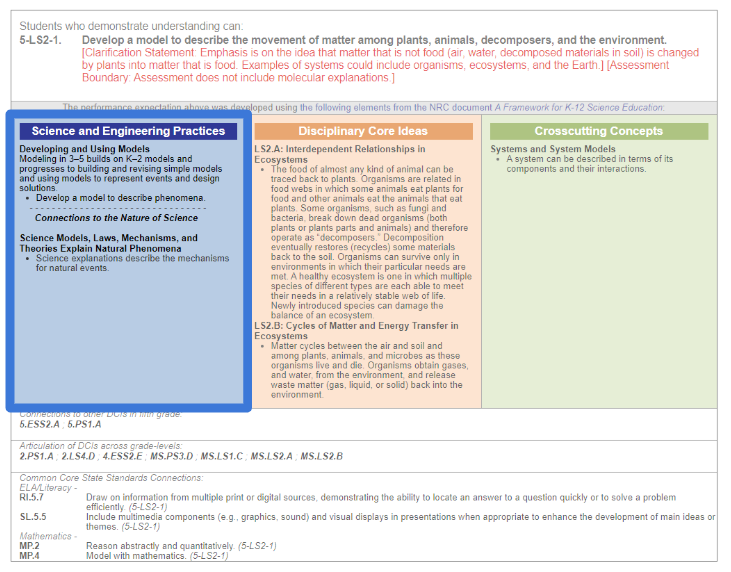
In this section, we focus on the Science and Engineering Practices (SEPs). The SEPs are used throughout one's K-12 career and beyond. Many of the SEPs have a potent connection to environmental literacy work.
Lesson objectives:
- Understand what the Science and Engineering Practices are intended to do and why they are included in the Framework.
- Explore a resource that further explains the SEPs and learn about the Claim, Evidence, Reasoning process that can be used across all grade levels.
- Reflect on which SEPs you currently practice with students and which SEPs you could add into your environmental literacy programs.
Estimated lesson completion time: 1 hour
-
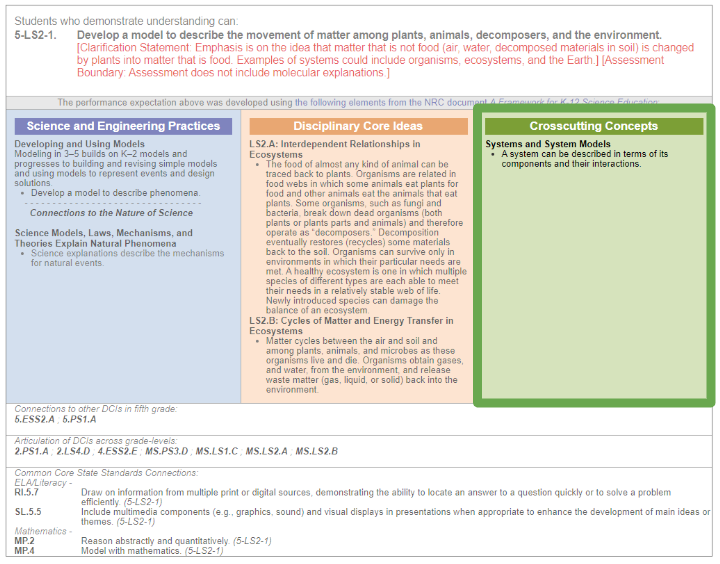
This section focuses on the Crosscutting Concepts (CCCs). CCCs guide students to connect different domains of science and deepen their understanding of scientific topics. As a student advances through school, their understanding and use of each concept should increase in complexity and should help them develop a more-coherent view of the scientific world.
Lesson objectives:
- Understand the seven Crosscutting Concepts introduced in the Framework.
- Reflect on how these concepts can be integrated into your lessons.
- Critique the proposed progression from grades K to 12 for each concept.
Estimated lesson completion time: 45 minutes
-
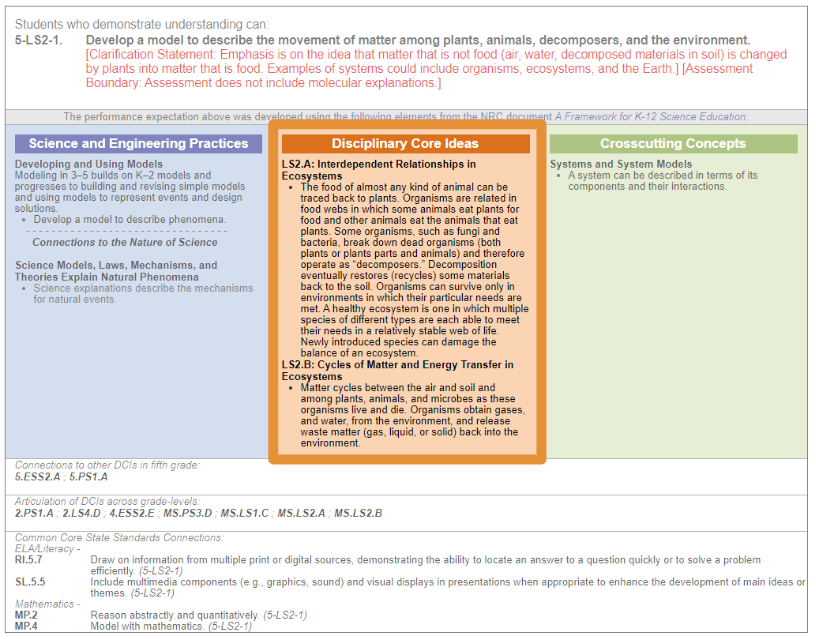
This section focuses on the last of the three dimensions of science learning: Disciplinary Core Ideas (DCIs).
Lesson objectives:
- Understand the four categories of Disciplinary Core Ideas.
- Learn how multiple DCIs are used to investigate a phenomenon.
- Understand how NGSS "Storylines" can be used to achieve grade-level performance expectations.
Estimated lesson completion time: 1 hour
-
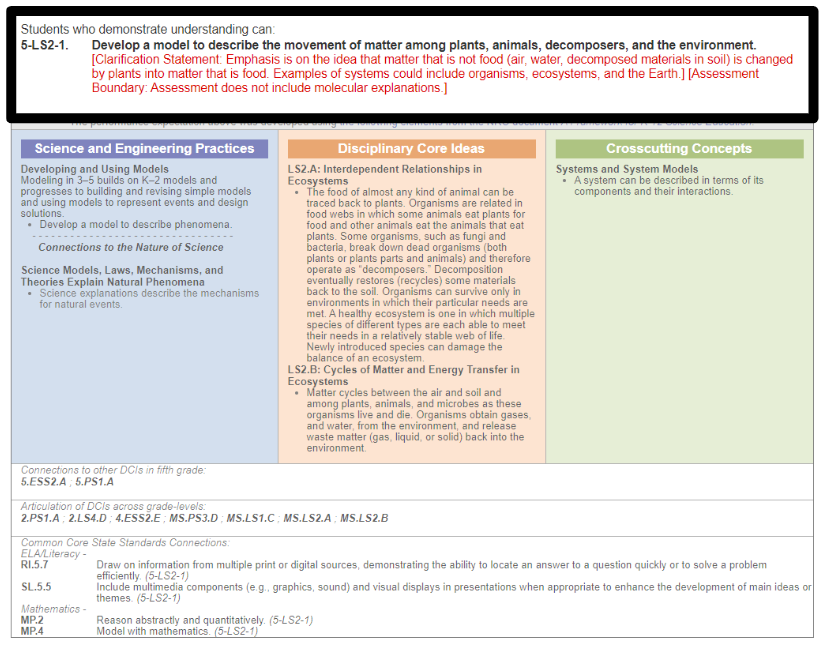
The three dimensions of learning in NGSS are:
These three dimensions work together to form each standard or performance expectation.
Lesson objectives:
- Practice reading an NGSS performance expectation.
- Understand the benefits and limitations of using evidence statements.
- Become familiar with the NGSS website.
Estimated lesson completion time: 1 hour
-
In this section, we look at the process you could take to connect environmental literacy (EL) programming to Disciplinary Core Ideas, Crosscutting Concepts and, Science and Engineering Practices.
Lesson objectives:
- Review resources that can help you connect EL programming to NGSS.
- Practice connecting an outdoor EL program to NGSS.
- Connect and/or strengthen the connection of one of your own EL programs to NGSS.
Estimated lesson completion time: 2 hours
-
-
Students mustGo through the activity to the end
-
-
After connecting your programs to NGSS, you may want to use an additional resource to evaluate the connections. This section explores resources designed for the formal and nonformal education community to evaluate lessons and programs supportive of NGSS. Review the tools now or after you have evaluated one of your environmental literacy programs.
The tools designed for nonformal education programs are conscious of the limited time nonformal educators may have with students. If you are able to see the same group of students multiple times within a school year, there might be elements from all these screener tools that will help in your program evaluation. Use the rubric or mix of rubrics that make the most sense for your context.
-
This screener tool is designed for classroom lessons.
-
This is a version of the EQuIP rubric that has been modified for nonformal environmental educators. It is a word document so you may find it helpful to make edits to better suit your situation.
-
This screener tool was designed to identify linkages between NGSS and nonformal education programs.
-
-
-
During the summer of 2015, the Maryland State Department of Education (MSDE) ran a number of College and Career Readiness Conferences around the state of Maryland. The resources are organized based on subjects--in the resource list you'll find Environmental Literacy, Science, and STEM among many others.
-
Achieve has a collection of sample tasks (lessons based on my look at them) that help illustrate how NGSS may be applied. A couple of them directly relate to Environmental Literacy Programming (watersheds). Visit this site to check them out.
-
These cards can be printed and cut out to help you map out a curriculum's alignment to NGSS. This card deck is also useful in a workgroup or workshop context when multiple educators may be thinking together on how to align lessons to NGSS.
-